By Abhinav Chhabra, Ledger Brigade | 22 October 2026
If you moved back to India from the US, Canada, the UK or Australia, you probably still hold something overseas: a 401(k), an RRSP or TFSA, an ISA, a super balance, vested RSUs or an old bank account. Once you become an ordinarily resident in India, these generally need to appear in Schedule FA of your income tax return every year, whether or not they earned anything.
Many returning Indians missed this, often for several years. India now gets account data from overseas through CRS and FATCA, and it shows up in the Foreign Assets Information section of your AIS. The department has been sending advisory e-mails to taxpayers whose data shows overseas holdings.
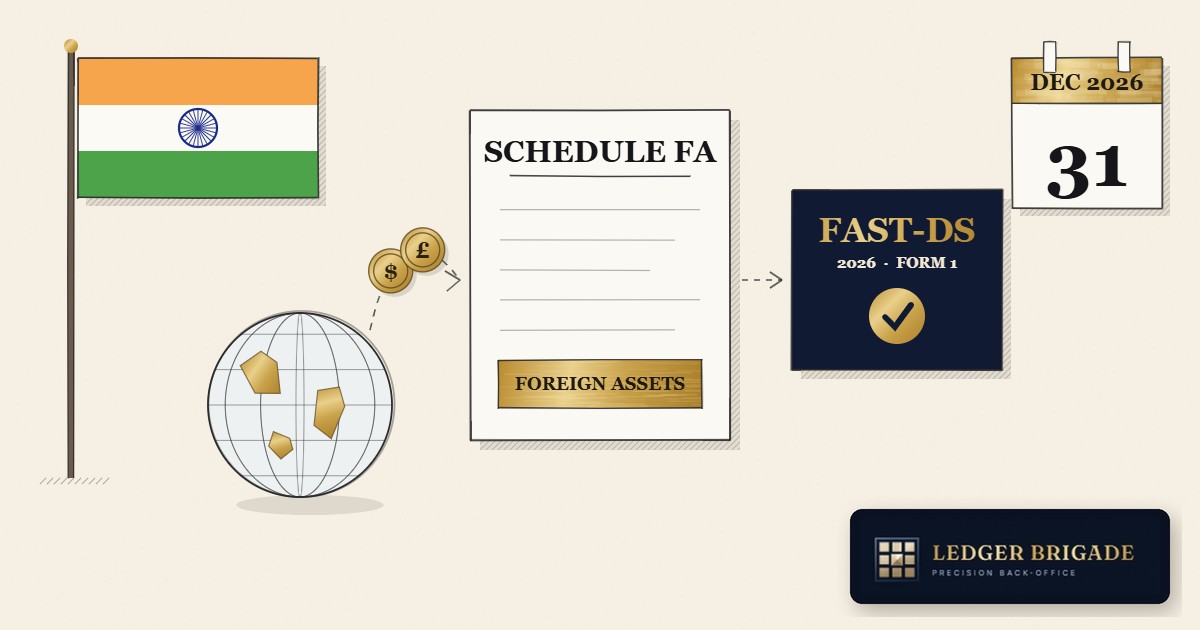
The Foreign Assets of Small Taxpayers Disclosure Scheme, 2026 (FAST-DS 2026) is a one-time way to put this right. It closes on 31 December 2026.
What changed
FAST-DS was announced in the Union Budget on 1 February 2026. It is enacted in Chapter IV (sections 130 to 144) of the Finance Act, 2026, with the FAST-DS Rules notified under CBDT Notification No. 114/2026. The scheme started on 16 August 2026, and declarations are filed online in Form 1 on the e-filing portal.
The past years being cleaned up fall under the Income-tax Act, 1961, so the scheme uses 1961 Act references: residence under section 6 and reassessment under section 147. From tax year 2026-27, your ongoing reporting moves to the Income-tax Act, 2025, but the obligation to report foreign assets continues.
The numbers at a glance
| Item | Category 1 (Sl. No. 1) | Category 2 (Sl. No. 2) |
|---|---|---|
| What it covers | Undisclosed foreign asset (source unexplained) or foreign income never taxed in India | Foreign asset bought from income already taxed in India, or acquired while a non-resident, but not shown in the return's schedule |
| Value ceiling | Aggregate up to ₹1 crore | Asset value up to ₹5 crore |
| Amount payable | 30% tax + an equal additional amount = 60% of value | Flat ₹1 lakh fee |
| Valuation date | 31 March 2026 | 31 March 2026 |
| Last date to file Form 1 | 31 December 2026 | 31 December 2026 |
Timeline after you file:
- Form 2 (the department's order of the amount payable) is issued within one month from the end of the month you filed Form 1.
- Payment is due within two months from the end of the month you receive Form 2. A further two months is allowed with simple interest at 1% per month. After that, the declaration fails.
- Form 3 (your intimation of payment) is filed with proof of payment, using challan ITNS 289.
- Form 4 (the certificate) follows within one month from the end of the month Form 3 is filed.
What it means for you
Who can use it? Anyone who was resident in India in the relevant year. Current non-residents and RNORs can also use it if they were resident either in the year the income arose or in the year the asset was acquired.
Who can't? Cases where proceedings for proceeds of crime are pending under the PMLA, cases where a Black Money Act assessment for that year is already completed, and Category 2 assets above ₹5 crore.
What does a valid declaration buy? Immunity from further tax, penalty and prosecution under the Black Money Act for the declared asset or income. The trade-off is that you can't later seek rectification or revision of those past assessments.
Why it matters: the Black Money Act carries a fixed ₹10 lakh penalty for failing to disclose a foreign asset in your return (sections 42 and 43). Since 1 October 2024, that penalty doesn't apply where the aggregate value of foreign assets, other than immovable property, doesn't exceed ₹20 lakh. So for small balances the risk is lower, but it isn't zero, and untaxed income is still taxable.
Worked examples
These are illustrative, not client cases.
1. A returning engineer from Canada (Category 2). Priya returned in 2022 and became an ordinarily resident from FY 2023-24. Her RRSP and a Canadian chequing account were funded entirely from Canadian salary earned while she was a non-resident. She never filled Schedule FA. The revision windows for those earlier years have closed. Because the assets were acquired while she was non-resident and her total is well under ₹5 crore, Category 2 is likely to apply, for a flat ₹1 lakh. One caution: if she had kept contributing after becoming resident, from income that was never taxed in India, that part could fall under Category 1 instead.
2. Untaxed income plus an unexplained account (Category 1). This is the official FAQ's own example. A foreign bank account valued at ₹60 lakh plus ₹20 lakh of undeclared foreign income gives a combined ₹80 lakh (within the ₹1 crore cap). Tax is ₹24 lakh plus an additional ₹24 lakh, so ₹48 lakh in total.
3. The bank account valuation trap. For a foreign bank account, value isn't today's balance. It's the sum of all deposits from the date the account was opened to 31 March 2026, excluding redeposits of money withdrawn from that same account. An account that has cycled salary for ten years can show a value far above its balance. This matters most under Category 1, where you pay 60% of value.
Payment timing (illustrative): if you file Form 1 on 15 December 2026, Form 2 should come by 31 January 2027. If you receive it in January, payment is due by 31 March 2027, or by 31 May 2027 with interest.
Action checklist
- Log in to the e-filing portal yourself (don't click e-mail links) and open AIS → Foreign Assets Information.
- List every foreign holding: bank and brokerage accounts, retirement accounts, RSUs/ESOPs, insurance, property, and interests in foreign entities.
- Map your residential status year by year (ROR, RNOR or non-resident). Schedule FA obligations and FAST-DS eligibility both depend on it. For FY 2025-26 and tax year 2026-27, our free NRI residency checker works it out for you.
- Compare with Schedule FA and Schedule FSI in every return you've filed since becoming resident.
- For each gap, decide: reporting-only (Category 2), untaxed or unexplained (Category 1), or within the ₹20 lakh Black Money Act carve-out.
- Gather statements from account opening, proof of source of funds, and valuer reports for property or unquoted shares.
- Aim to file Form 1 by mid-December, and plan cash for the Form 2 payment.
- From this year onwards, report foreign assets correctly in every return, starting with your AY 2026-27 return (due 31 July, or 21 November 2026 for audit cases).
Frequently asked questions
Is FAST-DS the same as revising my return?
No. A revised return only works while that year's window is open. FAST-DS can cover earlier years and gives Black Money Act immunity for what you declare.
I'm back to being an NRI. Can I still use it?
Yes, if you were resident in India in the year the income arose or the asset was acquired.
Does filing Form 1 give me immunity?
Not on its own. You need to pay the Form 2 amount within the time allowed and complete Forms 3 and 4.
Can I declare several assets in one form?
Yes. Multiple assets and income items can go in one Form 1, and the ceilings apply to their aggregate value.
Is the payment refundable if I pay under the wrong head?
The portal says a payment made under an incorrect minor head in ITNS 289 cannot be corrected or refunded. Check the challan carefully.
Need a second pair of eyes?
If you've moved back from the US, Canada, the UK or Australia and aren't sure which category your foreign accounts fall into, email hello@ledgerbrigade.com or book a briefing.
Have you checked the Foreign Assets Information section of your AIS yet? Tell us in the comments.
Disclaimer: This article is general information, not tax or legal advice. Rules, thresholds and dates can change. Confirm your position with a qualified professional before acting.
Comments (0)
Be the first to comment.
Leave a comment