By Abhinav Chhabra, Ledger Brigade | 25 October 2026
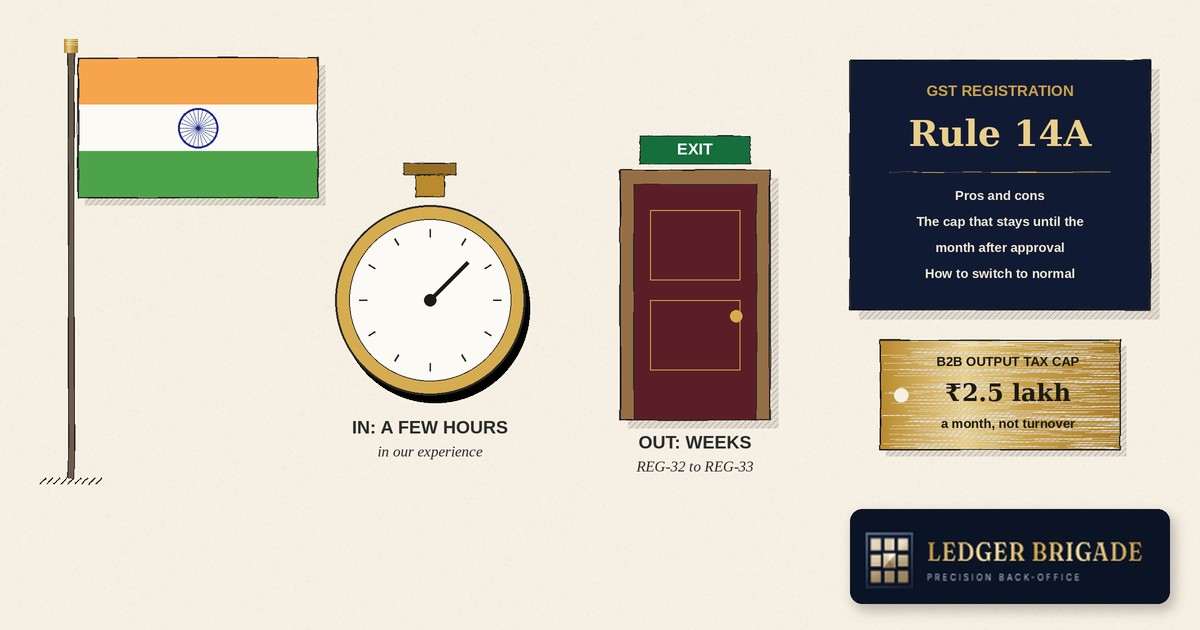
Since 1 November 2025, small businesses can get a GST registration under Rule 14A of the CGST Rules, a simplified route that the law promises within three working days. In practice it is often much faster: applications Ledger Brigade has filed under Rule 14A recently have been approved within 3 to 5 hours.
That speed is real, and for many businesses Rule 14A is the right choice. But the rule has a catch that most "register in a day" offers do not mention: getting in takes hours, while getting out can take weeks, and until you are out, you are held to a cap on your B2B sales. This guide sets out exactly what the rule says, who should use it, who should not, and how to switch to a normal registration when your business outgrows it.
1. What Rule 14A is
Rule 14A was inserted into the CGST Rules by Notification No. 18/2025-Central Tax (31 October 2025, in force from 1 November 2025). It is an option you tick when applying for registration in Form GST REG-01. If you opt in:
- you must complete Aadhaar authentication, unless you are among the persons notified as exempt under section 25(6D) of the CGST Act (sub-rule 2);
- the portal grants the registration electronically, within three working days of your application (sub-rule 4), with no officer visit at this stage;
- you cannot hold more than one Rule 14A registration in the same State or Union territory under the same PAN (sub-rule 3).
The timing is not guaranteed in every case: the portal's risk checks can still route an application for review.
2. The ₹2.5 lakh test: it is not your turnover
This is where most people go wrong. Rule 14A is available only if your output tax on supplies to registered persons (businesses with a GSTIN) does not exceed ₹2,50,000 a month, counting CGST, SGST or UTGST, IGST and compensation cess together (sub-rule 1).
Two things follow:
- Sales to consumers do not count. A café, a shop or a salon selling mostly to the public can have a large turnover and still stay well under the cap.
- B2B sales add up fast. At 18% GST, ₹2.5 lakh of tax corresponds to about ₹13.9 lakh of B2B sales a month. At 5%, it is about ₹50 lakh.
| Your business | Monthly sales to registered businesses | GST rate | B2B output tax | Within the cap? |
|---|---|---|---|---|
| A café in Dwarka selling mostly to walk-in customers | ₹40,000 (a few office orders) | 5% | ₹2,000 | Yes, comfortably |
| A freelance designer billing companies | ₹3 lakh | 18% | ₹54,000 | Yes |
| A small IT services firm with three corporate clients | ₹12 lakh | 18% | ₹2,16,000 | Yes, but close |
| The same firm after winning a fourth client | ₹16 lakh | 18% | ₹2,88,000 | No: must switch |
Illustrative figures.
3. The pros
- Speed. Hours in practice, three working days at most under the rule, against up to seven working days (or thirty with physical verification) on the normal route.
- No officer visit at entry. Approval is electronic once Aadhaar authentication succeeds.
- A natural fit for B2C businesses. If most of your customers are consumers, the cap may never matter: it has nothing to do with your turnover, so even a large retailer selling to the public can qualify.
- Good for testing an idea. A new venture with modest, predictable B2B sales can start invoicing almost immediately.
4. The cons: what the fine print says
1. Leaving is slow, by design. To switch to a normal registration you must apply in Form GST REG-32, and the application is verified under the normal registration rules (sub-rule 9): the officer can raise queries, and the REG-32 declaration itself refers to physical verification of your place of business. The scrutiny you skipped at entry can arrive at exit. Allow one to six weeks, depending on your jurisdiction.
2. The cap stays until the month after approval. Even after the officer approves your switch, you can report B2B output tax above ₹2.5 lakh only from the first day of the month after the approval order (sub-rule 11). If a large B2B order arrives while you are still under Rule 14A, you can be left with sales you cannot report in full on time, and your customers' input tax credit depends on that reporting. For a supplier to businesses, that is a serious commercial problem.
3. No back-filling. Once you have switched, you cannot amend earlier months' returns to show B2B output tax above the cap for the period before the switch (sub-rule 12).
4. You cannot leave whenever you like. You can file REG-32 only after furnishing returns for at least one tax period (three months if filed before 1 April 2026) and all returns due since registration, and only if no cancellation proceedings under section 29 have been started (sub-rule 5). If cancellation proceedings start after you apply, the withdrawal is rejected (sub-rule 13).
5. Changes freeze while you wait. Any change in your registration details (address, partners, business activity) must be amended before you file REG-32 (sub-rule 6), and while REG-32 is pending you cannot file amendments or apply for cancellation (instructions to Form REG-32).
6. Extra checks at exit. Depending on the portal's risk checks, the switch may need biometric Aadhaar authentication, a photograph and verification of original documents (sub-rule 7).
5. Should you choose Rule 14A?
| Choose Rule 14A if… | Choose normal registration if… |
|---|---|
| Most of your sales are to consumers | You sell mainly to other businesses |
| Your B2B sales are small and steady (well under about ₹10 to 12 lakh a month at 18%) | Your B2B sales are close to ₹13.9 lakh a month at 18%, or growing |
| You need to start invoicing within days | A large B2B order or contract is likely soon |
| Your registration details are unlikely to change soon | You expect to add partners, branches or a new address |
Our rule of thumb: if a B2B customer could double your sales in a single month, take the normal route. A few days' wait at the start costs far less than a stalled switch later.
6. How to switch from Rule 14A to normal registration
You keep the same GSTIN; only the Rule 14A option is withdrawn.
- Check eligibility. All returns filed up to date; at least one tax period of returns furnished; no cancellation proceedings pending.
- Amend first. If anything in your registration has changed, file and complete the amendment before going further.
- File Form GST REG-32 on the GST portal (Services, Registration, application for withdrawal from Rule 14A), giving the reason (usually that B2B output tax will exceed ₹2.5 lakh a month), and verify it with an electronic verification code.
- Complete Aadhaar authentication of the primary authorised signatory and one promoter or partner. The acknowledgment (ARN) is generated only after this succeeds; if the portal requires it, this can include biometric authentication and document verification.
- Respond to any queries the officer raises (Form REG-03) and arrange for a physical verification if one is ordered.
- Receive Form GST REG-33, the order allowing the withdrawal, with the amended registration certificate on your dashboard.
- From the first day of the following month, report your full B2B output tax.
Plan the timing: because the higher limit opens only from the month after approval, file REG-32 as soon as you can see the cap coming, not after you have crossed it.
Frequently asked questions
Is Rule 14A compulsory for small businesses?
No. It is an option you choose in the registration application. You can always apply through the normal route instead.
Does the ₹2.5 lakh limit include sales to consumers?
No. Only output tax on supplies to registered persons counts.
Do I get a new GSTIN when I switch?
No. The officer's order in Form REG-33 withdraws the Rule 14A option and the same GSTIN continues.
Can I switch straight after registering?
Not immediately: before filing the withdrawal application (Form REG-32), you must have furnished returns for at least one tax period, along with all returns due since registration. (For withdrawal applications filed before 1 April 2026, the minimum was three months of returns.)
How fast is Rule 14A in practice?
The rule allows up to three working days. Applications we have filed recently have been approved within 3 to 5 hours, but this is not guaranteed.
How Ledger Brigade can help
We handle GST registrations week in, week out, through both routes, and we help businesses decide which one fits before they apply.
| Service | Fee |
|---|---|
| GST registration (normal or Rule 14A): sole proprietorship | ₹1,500 |
| GST registration (normal or Rule 14A): partnership, LLP or private limited company | ₹2,500 |
| Switching from Rule 14A to normal registration (Form REG-32, queries, follow-up): sole proprietorship | ₹1,500 |
| Switching from Rule 14A to normal registration: partnership, LLP or private limited company | ₹2,500 |
| Department visit, if a physical verification or hearing needs attendance | ₹2,000 per visit (Delhi, Haryana and Noida); elsewhere, travel and stay at actuals |
Email hello@ledgerbrigade.com or book a briefing. Not sure whether you need GST registration at all? Read our guide, Do You Need GST Registration?
Did you choose Rule 14A, and would you choose it again? Tell us in the comments.
Important information. This article is general information about GST registration under Rule 14A of the CGST Rules, 2017, stated as at 25 October 2026. It is not tax or legal advice. Approval times quoted from our experience are not guaranteed, and officers' timelines vary by jurisdiction. Confirm your position with a qualified adviser before applying or withdrawing.
Sources
- Notification No. 18/2025-Central Tax dated 31 October 2025 (Central Goods and Services Tax (Fourth Amendment) Rules, 2025): rule 9A, rule 14A (sub-rules 1 to 13), and Forms GST REG-32 and REG-33.
- Central Goods and Services Tax Rules, 2017, rules 8, 9 and 19.
- Central Goods and Services Tax Act, 2017, sections 25 and 29.
- GSTN advisory of 21 February 2026 on the facility to withdraw from Rule 14A through Form GST REG-32.
Comments (0)
Be the first to comment.
Leave a comment