By Abhinav Chhabra, Ledger Brigade | 26 October 2026
"Which structure should I start with?" is the first question almost every founder asks us, and the honest answer is: it depends less on what sounds impressive and more on four things. How much risk the business carries, how many owners there are, whether you will raise money, and how much compliance you can live with.
This guide compares the four common structures in India, plus the one person company, and then lists every registration each one needs: the compulsory ones, the ones that depend on what you do, and the ones you should take even when the law does not require them.
The short answer: who should choose what
| If you are… | Start as | Why |
|---|---|---|
| A freelancer, consultant or small trader, working alone, with low business risk | Sole proprietorship | Fastest and cheapest to start, lightest compliance, and profit up to ₹12 lakh can be tax-free under the new regime |
| A single founder who wants limited liability, or plans to grow and hire | One person company (OPC) | Company structure and limited liability, with one owner |
| Two or more people running a small, low-risk family or local business | Partnership firm | Simple to set up with a partnership deed; fewer filings than an LLP |
| Professionals or partners (consultants, agencies, firms of experts) who want limited liability without company-level compliance | Limited liability partnership (LLP) | Limited liability, flexible profit sharing, and no compulsory audit until turnover crosses ₹40 lakh or contribution crosses ₹25 lakh |
| A start-up planning to raise investment, issue ESOPs, take foreign investment, or sell to large corporates | Private limited company | The only structure investors and venture funds expect; shares are easy to issue and transfer |
Rule of thumb: if a single unpaid bill, lawsuit or loan default could reach your personal house and savings, choose a structure with limited liability (OPC, LLP or private limited company) from day one.
The structures side by side
| Sole proprietorship | Partnership firm | LLP | Private limited company | |
|---|---|---|---|---|
| Owners | 1 | 2 or more (up to 50) | 2 or more designated partners (no maximum) | 2 to 200 shareholders (1 for an OPC) |
| Your personal liability | Unlimited | Unlimited, and joint | Limited to your agreed contribution | Limited to your shares |
| Separate legal entity? | No | No | Yes | Yes |
| How it is formed | No formal registration; business is identified through GST, Udyam or other registrations | Partnership deed; registration with the Registrar of Firms is optional but recommended | Incorporated with the Registrar of Companies (MCA) | Incorporated with the Registrar of Companies (MCA) |
| Income tax (tax year 2026-27) | Owner's slab rates (new regime: nil up to ₹4 lakh, rising to 30% above ₹24 lakh; no tax up to ₹12 lakh after the rebate) | 30% on the firm's profit, plus cess (and surcharge above ₹1 crore) | Same as a partnership firm | 25% (if turnover is up to ₹400 crore), or 22% under the concessional option (about 25.17% with surcharge and cess) |
| Statutory audit | Only a tax audit, if turnover crosses the income-tax limits | Only a tax audit, if turnover crosses the limits | Compulsory if, in any financial year, turnover exceeds ₹40 lakh or contribution exceeds ₹25 lakh | Always compulsory |
| Annual government filings | Income tax return (and GST, TDS if applicable) | Same, for the firm | Plus Form 11 (annual return) and Form 8 (accounts and solvency) | Plus AOC-4 (financial statements), MGT-7 or MGT-7A (annual return), DIR-3 KYC for directors, board meetings and an AGM |
| Raising money | Loans only | Loans and partners' capital | Partners' capital; venture investors rarely invest | Equity, convertible notes, ESOPs, foreign investment |
| Ease of exit or sale | Business assets are sold one by one | Depends on the deed | Partnership interest can be transferred under the LLP agreement | Shares can be sold or transferred |
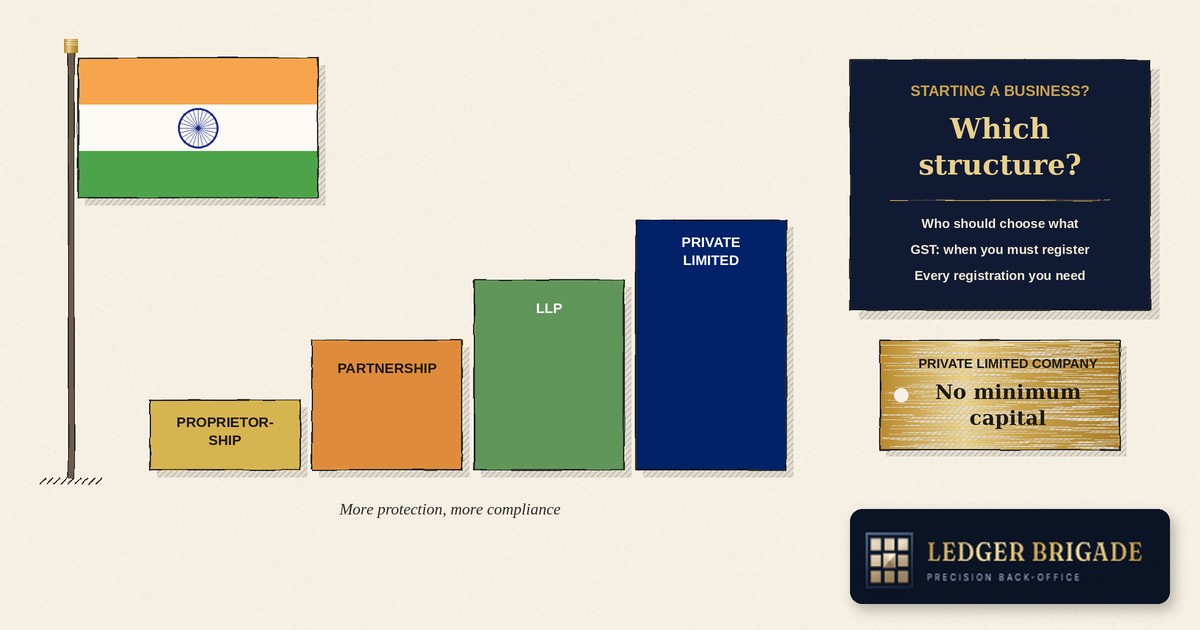
No minimum capital: a private company does not need ₹1 lakh (or any minimum) of paid-up capital to be formed; the legal minimum was removed in 2015. Founders choose the capital they need.
What a "small company" saves
Most new private companies are "small companies": since 1 December 2025, that means paid-up capital up to ₹10 crore and turnover up to ₹100 crore (previously ₹4 crore and ₹40 crore). Small companies need only two board meetings a year, file a shorter annual return (MGT-7A), and need not prepare a cash flow statement. Holding and subsidiary companies cannot be small companies.
The tax question, in plain numbers
Illustrative; tax year 2026-27, new regime, ignoring other income and deductions.
| Profit kept in the business | Sole proprietor | Partnership firm or LLP | Private limited company (22% option) |
|---|---|---|---|
| ₹10 lakh | Nil (rebate up to ₹12 lakh) | ₹3,12,000 | ₹2,51,680 |
| ₹20 lakh | ₹2,08,000 | ₹6,24,000 | ₹5,03,360 |
Read this table carefully: it shows tax on profit kept in the business. In practice, firms, LLPs and companies pay their owners:
- partners can receive remuneration and interest on capital, which the firm deducts and the partners pay tax on at their own slab rates. The limits carried over unchanged into the new Act: remuneration up to the higher of ₹3 lakh or 90% of the first ₹6 lakh of book profit, plus 60% of the rest, and interest up to 12% a year, if the deed provides for them;
- directors can receive a salary, which the company deducts and the director pays tax on as salary income.
Done well, this spreads profit across people and slabs, and the totals can come much closer. Done badly, profit is taxed twice: once in the company and again when paid out as dividends. The structure decision should be made with the tax plan, not after it.
Does each structure need GST registration?
GST does not depend on your structure. A proprietor, a firm, an LLP and a company follow exactly the same rules. You must register when:
- your aggregate turnover in a financial year crosses ₹40 lakh if you supply only goods, or ₹20 lakh if you supply services (lower limits apply in some special category States); or
- you fall into a compulsory registration category, whatever your turnover: for example, making certain inter-State supplies of goods, selling goods through e-commerce platforms (subject to the relaxations for small sellers), being liable under reverse charge, or acting as an e-commerce operator or input service distributor.
Aggregate turnover is counted per PAN, across India, so a proprietor's turnover from all their businesses is added together.
Many businesses register voluntarily before crossing the limit, because larger customers prefer suppliers who charge GST and give them input tax credit.
New businesses can now register fast: under Rule 14A, the law promises registration within three working days (in our experience it is often approved within hours), but it comes with a cap: no more than ₹2.5 lakh a month of output tax on supplies to registered businesses, which matters as you grow. Read our guides Do You Need GST Registration? and GST Registration in Hours Under Rule 14A: The Pros, the Cons, and How to Switch before choosing.
Every registration you will need
Step 1: setting up the structure
| Registration | Proprietorship | Partnership | LLP | Private limited company |
|---|---|---|---|---|
| PAN of the business | Your personal PAN | Firm's PAN | LLP's PAN (issued at incorporation) | Company's PAN (issued at incorporation) |
| TAN (to deduct TDS) | When you deduct TDS | When you deduct TDS | Issued at incorporation | Issued at incorporation |
| Formation documents | None | Partnership deed (stamped); Registrar of Firms registration recommended | Incorporation through the MCA portal; LLP agreement filed within 30 days | Incorporation through the MCA portal with memorandum and articles |
| Digital signature (DSC) | For some filings | For some filings | For designated partners | For directors |
| Current bank account | Needs proof of business (GST, Udyam or Shops and Establishments certificate) | In the firm's name | In the LLP's name | In the company's name |
| Within the first months | None | None | None | Declaration of commencement of business (INC-20A) within 180 days; first auditor appointed within 30 days (ADT-1) |
An unregistered partnership firm cannot sue third parties to enforce its contracts (section 69 of the Indian Partnership Act, 1932), which is why we recommend registering the firm.
Step 2: registrations that depend on your business
| Registration | When you need it |
|---|---|
| GST | Turnover above the limits, or a compulsory category (see above) |
| Shops and Establishments | When you run a shop, office or establishment, under your State's law (rules and thresholds vary by State) |
| Professional tax | In States that levy it (for example Maharashtra, Karnataka, West Bengal), for the business and its employees; Delhi does not levy it |
| EPF | Once you employ 20 or more people (voluntary below that) |
| ESI | Once you employ 10 or more people in covered areas |
| Import Export Code (IEC) | If you import or export goods (and often for exporting services, for bank and foreign exchange purposes) |
| FSSAI | If you make, store, sell or deliver food |
| Trade licence | Many municipal bodies require one for trade premises |
| Industry licences | Sector-specific: drugs, chemicals, pollution consent, money-lending, travel and so on |
Step 3: worth taking even when not compulsory
- Udyam (MSME) registration: there is no government fee, and it unlocks MSME benefits, including protection against late payment by buyers (payments due within 45 days where agreed) and access to priority-sector lending and some government tenders.
- Trademark: register your brand name and logo before you spend on marketing; someone else filing first can force a costly rebrand.
- Startup India (DPIIT) recognition: available to private limited companies, LLPs and registered partnership firms that qualify; it opens up specific tax and compliance benefits and government schemes.
- Voluntary GST registration: if your customers are mostly businesses, being able to charge GST can win larger clients.
- A founders' agreement or detailed partnership deed / LLP agreement: who owns what, who decides what, and what happens if someone leaves.
- Books from day one: proper accounting software and a compliance calendar from the first invoice cost far less than reconstructing a year of records later.
- Letter of Undertaking (LUT) for exporters: lets you export goods or services without paying IGST up front (read our export compliance pack).
- Business insurance: especially for professional liability, stock and premises.
The compliance you sign up for
| Every year | Proprietorship | Partnership | LLP | Private limited company |
|---|---|---|---|---|
| Income tax return | ✓ | ✓ | ✓ | ✓ |
| Tax audit (above the income-tax turnover limits) | ✓ | ✓ | ✓ | ✓ |
| GST returns (if registered) and TDS returns (if deducting) | ✓ | ✓ | ✓ | ✓ |
| Statutory audit | If turnover above ₹40 lakh or contribution above ₹25 lakh | ✓ always | ||
| Annual MCA filings | Form 11 (by 30 May) and Form 8 (by 30 October) | AOC-4, MGT-7 or MGT-7A, DIR-3 KYC | ||
| Board meetings and AGM | ✓ (2 board meetings a year for a small company) |
The company's extra compliance is the price of limited liability, investor-readiness and credibility. For a growing business it is usually worth paying; for a one-person consulting practice it often is not, at least at the start.
Changing structure later
You are not locked in:
- a sole proprietorship can be converted into a company, and a partnership firm into an LLP or a company. Under section 70 of the Income-tax Act, 2025 (which replaced section 47 of the 1961 Act), the transfer of assets on such a conversion is not taxed as a capital gain if strict conditions are met: broadly, all the assets and liabilities pass to the company, the former owners become its shareholders, and they keep at least 50% of the voting power for five years. Breaking a condition later can bring the tax back, so plan the conversion with an adviser;
- an OPC can convert into a private limited company as the business grows.
Conversions take time and paperwork, though, so if you already know you will raise investment within a year or two, start as a private limited company.
Frequently asked questions
Is a private limited company always better?
No. It brings limited liability and investor-readiness, but also a compulsory audit and annual MCA filings every year, even with no business. For a small, low-risk solo practice, a proprietorship or an LLP is often the better start.
Do I need GST registration just because I formed a company?
No. GST depends on turnover and the type of supply, not the structure. A new company with turnover below the limit and no compulsory category does not need to register (though many do so voluntarily).
Can I run a proprietorship and a company at the same time?
Yes, but they are separate. Remember that GST turnover is counted per PAN, and the proprietorship uses your personal PAN.
LLP or private limited company for a start-up?
If you will raise venture capital or issue ESOPs, choose a private limited company. If you are a services firm owned by working partners with no outside investors, an LLP is usually simpler and cheaper.
How long does registration take?
A company or LLP is typically incorporated within one to two weeks when documents are in order; a GST registration under Rule 14A can be approved within hours.
How Ledger Brigade can help
We help founders choose the structure, set it up, and stay compliant afterwards, with work reviewed by qualified CAs.
| Service | Fee |
|---|---|
| Private limited company, LLP or OPC incorporation | ₹7,500 professional fee (government fees, stamp duty and DSC at actuals, with receipts) |
| GST registration | ₹1,500 (proprietorship); ₹2,500 (partnership, LLP or company) |
| MCA annual filing package for companies (AOC-4 and MGT-7) | ₹5,999 a year |
| Bookkeeping in your own Tally or Zoho Books | From ₹4,999 a month |
Email hello@ledgerbrigade.com or book a briefing and we will help you pick the right structure before you register.
Which structure did you start with, and would you choose it again? Tell us in the comments.
Important information. This article is general information about business structures and registrations in India, stated as at 26 October 2026. It is not legal or tax advice. Tax outcomes depend on your full circumstances, State laws and licences vary, and limits change through budgets and notifications. Take advice on your own situation before choosing a structure.
Sources
- Companies Act, 2013, and the Companies (Specification of Definition Details) Amendment Rules, 2025 (G.S.R. 880(E), 1 December 2025: small company limits of ₹10 crore paid-up capital and ₹100 crore turnover).
- Limited Liability Partnership Act, 2008, and Limited Liability Partnership Rules, 2009 (audit limits, Forms 3, 8 and 11).
- Indian Partnership Act, 1932, section 69.
- Income-tax Act, 2025, section 35(e) (partners' remuneration and interest; formerly section 40(b) of the 1961 Act) and section 70 (transactions not regarded as transfer; formerly section 47).
- Code on Social Security, 2020 (in force from 21 November 2025): EPF and ESI coverage thresholds.
- Central Goods and Services Tax Rules, 2017, rule 14A (Notification No. 18/2025-Central Tax, 31 October 2025).
- Companies (Amendment) Act, 2015 (removal of minimum paid-up capital).
- Income-tax Act, 2025 and the Finance Act, 2025 rates as continued for tax year 2026-27 by Budget 2026 (new-regime slabs and rebate; rates for firms, LLPs and companies).
- Central Goods and Services Tax Act, 2017, sections 22 to 25, and related notifications on threshold limits.
- Micro, Small and Medium Enterprises Development Act, 2006 (Udyam registration and delayed payment provisions).
Comments (0)
Be the first to comment.
Leave a comment